Working question
What this page resolves
How can an agricultural project improve production while managing seasonal and ecological realities?

Specialist · Sector resource
Use Agriculture to support clearer decisions and stronger delivery.
A sector-focused resource for applying sound project practices to agriculture initiatives. The guide follows a page-specific path built around this question: How can an agricultural project improve production while managing seasonal and ecological realities?
Draft for page-by-page review. Provider claims, examples and commercial terms remain evidence-gated.
At a glance
Sector resource
This page follows a route designed for this subject, beginning with a real working situation and ending with an evidence-based next decision.
Working question
How can an agricultural project improve production while managing seasonal and ecological realities?
Applied situation
A farm or producer group introducing new practices, equipment and market channels.
Evidence of value
Productivity, profitability, resource condition, resilience and adoption.
The central question for Project Management for Agriculture is this: How can an agricultural project improve production while managing seasonal and ecological realities? That question is more useful than a broad definition because it identifies the decision a sponsor or project team must make. In this guide, agriculture is treated as part of delivery work—with constraints, consequences and ownership—not as a fashionable label added to an existing plan.
Consider a farm or producer group introducing new practices, equipment and market channels. The team cannot resolve that situation by selecting a template first. It must understand what is changing, who experiences the result, where authority sits and which assumptions could overturn the preferred response. The purpose of “Start with the production system” is to frame that context before effort and money narrow the available choices.
For Agriculture, the pivotal management choice is to fit scope and schedule to crop or livestock cycles, cash flow and site conditions. Write that choice as a decision statement: the outcome sought, the person authorized to decide, the information required and the date after which delay creates a different consequence. This prevents a recommendation, workshop or technical preference from quietly becoming an approved commitment.
Use the scenario—a farm or producer group introducing new practices, equipment and market channels—to test the decision route. Ask who recommends, who contributes knowledge, who can approve, who may be affected and who must operate the result. If those roles disagree, record the trade-off and escalation path. “Respect season, biology and place” should leave the reader knowing what must be settled, not merely which terminology to use.
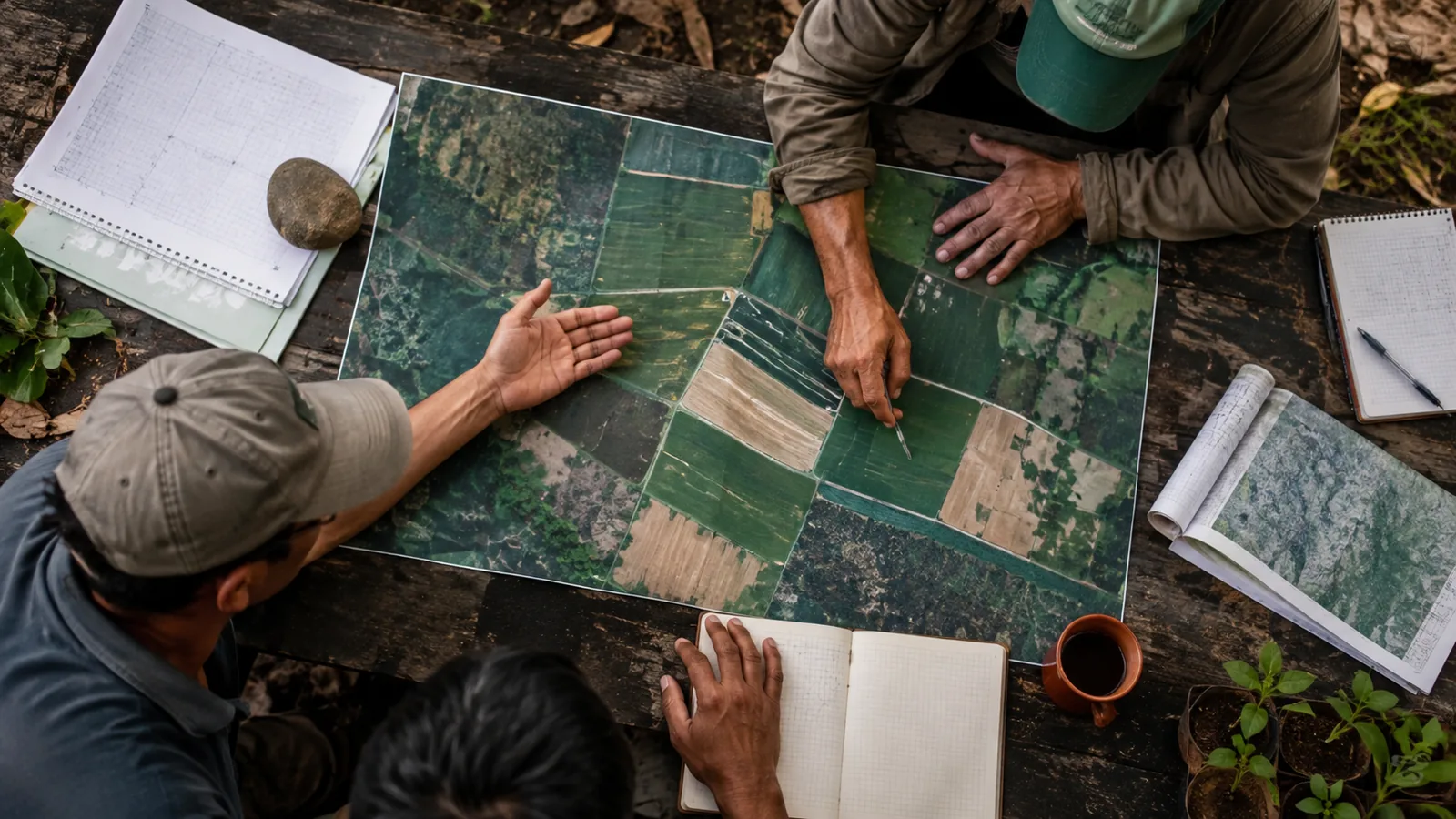
A defensible approach to agriculture needs evidence that is close to the real decision. For this page, that means yield, soil and water condition, input cost, labour, climate exposure and market requirements. Record the source, date, owner, scope and known limitation of each important input. Evidence from a different population, location, system or project phase may still be useful, but its transfer limits should be visible rather than assumed away.
Do not wait until the final report to discover whether the information can answer the question. During “Build the investment and adoption case,” review whether the evidence distinguishes a genuine change from normal variation, whether affected people can challenge the interpretation and whether missing data should lead to more research, a bounded test or a more cautious commitment.
Turn “Coordinate equipment, inputs and skills” into owned project work. Translate the intended result into deliverables, dependencies, acceptance conditions and decision points. In the case of a farm or producer group introducing new practices, equipment and market channels, the schedule should expose the moments when new evidence can still alter design, procurement, rollout or transition. A milestone that records only activity is weaker than one that tests a meaningful assumption.
Select predictive, iterative, agile or hybrid practices according to the uncertainty in agriculture, not according to habit. Name the people responsible for integration, quality, risk and stakeholder commitments. Make constraints and exclusions explicit. When specialist, legal, technical, cultural or community authority is required, bring it into the work instead of allowing a general project process to impersonate it.
The measurement question for Project Management for Agriculture is whether the project achieved productivity, profitability, resource condition, resilience and adoption. Build a small set of indicators around that statement. Include an early signal that can change delivery, an outcome measure that tests value and a balancing measure that reveals displaced cost, harm, overload or unequal impact. Activity counts may explain effort, but they should not be presented as the outcome.
For every measure used in “Test performance through a full cycle,” specify the calculation, boundary, baseline, frequency, data owner and decision it informs. Add structured qualitative evidence where experience or context cannot be reduced honestly to a single number. Review patterns and exceptions together; an average can conceal the group, location or operating condition where agriculture is failing.
Use “Adapt from farm-level evidence” to decide what happens after the first result. Compare the evidence with the original question—How can an agricultural project improve production while managing seasonal and ecological realities?—and with the decision to fit scope and schedule to crop or livestock cycles, cash flow and site conditions. Continue, adapt, expand, pause or stop for an explicit reason. Record which assumptions were supported, which were disproved and which remain too uncertain for a larger commitment.
Close the loop with the people who supplied information, accepted impact or inherited the result. In the working case of a farm or producer group introducing new practices, equipment and market channels, assign ownership for unresolved issues, future measurement and the next review date. Retain the rationale as well as the approval. That final discipline makes agriculture a source of organizational learning rather than another page, report or project that appears complete only because delivery activity ended.
Clear answers
How can an agricultural project improve production while managing seasonal and ecological realities?
The working situation is a farm or producer group introducing new practices, equipment and market channels. It is an illustrative scenario, not a claimed client project.
Fit scope and schedule to crop or livestock cycles, cash flow and site conditions. Record the owner, timing, assumptions, alternatives and consequences that matter to that choice.
Start with yield, soil and water condition, input cost, labour, climate exposure and market requirements. Confirm the source, date, boundary and limitations before using that evidence to support a commitment.
Evaluate productivity, profitability, resource condition, resilience and adoption. Include a balancing measure so that improvement in one area does not conceal displaced cost, burden or harm.
Fit scope and schedule to crop or livestock cycles, cash flow and site conditions.
Content reviewed: September 7, 2026
These external references support factual review. They are intentionally separated from the internal learning path above.